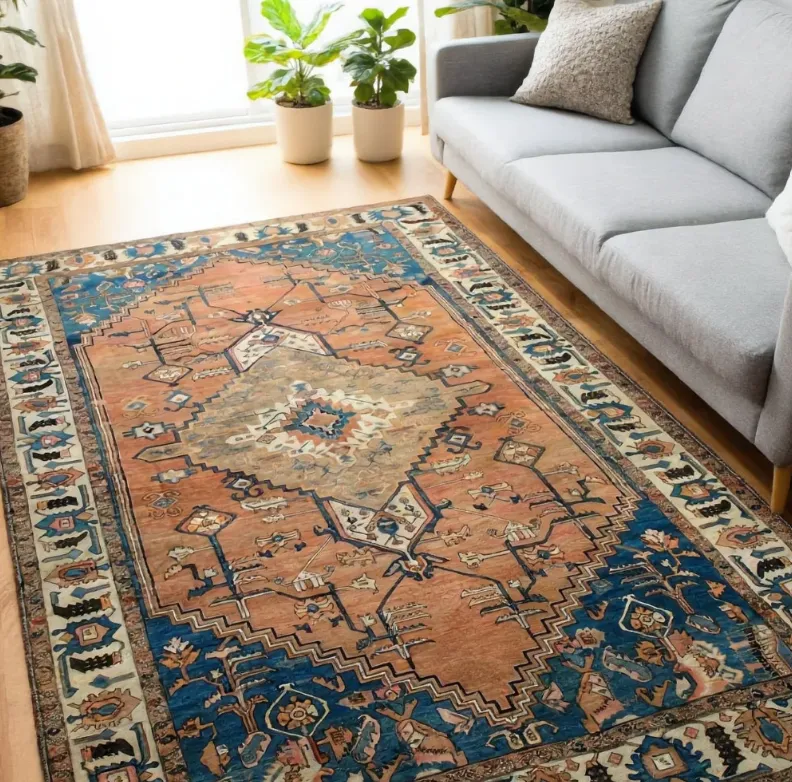
The biggest mistake people make while buying rugs is assuming that price and appearance tell the whole story. They do not. A designer rug can look luxurious in a product photograph, use words like premium, handmade, or high quality, and still leave you with one very basic problem:
You may not actually know what you are paying for.
That is the uncomfortable truth around rug buying in India. Most online guides tell you to check the size first, then material, then colour. Fair advice. But when two rugs look similar and one costs ₹8,000 while another costs ₹80,000, buyers are often left staring at the price difference with no real framework to understand it.
A good rug is not defined by one word such as wool, handmade, or luxury.
Its quality comes from the combination of material, construction, density, finishing and the amount of skilled work involved.
That distinction matters because a hand-knotted rug, a hand-tufted rug and a machine-made rug can all be called “rugs”, but they are not built in the same way and should not be judged by the same standards. Current 2026 buying guides continue to distinguish construction as a major factor in durability, feel, cost, and lifespan.
So, before buying a rug, forget the marketing language for a minute.
The better question is:
What can I actually inspect to know whether this rug is worth its price?
How Can You Tell if a Rug Is Actually Good Quality?
A good-quality, authentic handmade rug should give you clear information about what it is made of, how it is constructed, and how it is expected to perform over time. If you cannot get those three answers, you are still buying largely on appearance.
This is the first filter. Do not begin by asking whether the area rug is beautiful. Ask whether the product information is complete.
Check the material properly
“Natural fibre” is not a complete answer.
“Premium wool” is also not always a complete answer.
Look for:
- The actual fibre used.
- Whether it is 100% wool or a blend.
- What the secondary material is, if blended.
- Whether the pile and foundation use different fibres.
- Any specific material information that explains the rug’s feel and care.
Material affects more than softness. It influences how a rug wears, how it feels, how it is maintained and, in many cases, its price. That is why current 2026 rug guidance treats fibre choice as a core performance decision rather than just a styling preference.
Check the construction
This is where many buyers stop understanding the product. The most important question is: How was this rug made?
Broadly, you may encounter:
- Hand-knotted rugs.
- Hand-tufted rugs.
- Handwoven or flatweave rugs.
- Handloom rugs.
- Chain stitch embroidery.
These are not interchangeable production labels.
For example, hand knotted rugs are created by tying individual knots, while hand-tufted rugs are made by inserting yarn through a backing with a tufting tool. Chain-stitched rugs are made by creating continuous chain stitches with yarn, producing a distinct surface structure and finish. Each method involves different production time, labour, and structural characteristics.
Check the surface and finishing
Product photographs rarely make this easy, so ask for close-up views.
Look at:
- Whether the pile looks even where it should be even.
- Whether the edges are neatly finished.
- Whether the pattern remains clear.
- Whether the backing information is explained.
- Whether texture is part of the intended design or simply poor finishing.
Important note: Handmade variation is not automatically a defect. In a handmade rug, slight irregularity can be part of the construction. The real concern is poor structural finishing, not the absence of machine-like uniformity.
That distinction is critical when comparing handcrafted rugs with factory-produced products.
Why Do Two Similar-Looking Rugs Have Such Different Prices?
Because visual similarity tells you very little about the work, material, and construction hidden inside the rug. Two area rugs can share a colour and pattern while having completely different production costs and expected lifespans.
This is where buyers often get trapped by the photograph.
Imagine two beige geometric rugs.
Both are 5×8 feet.
Both look similar from a distance.
One is machine-made.
The other is hand-knotted from wool.
They should not cost the same.
The price difference can reflect several factors.
1. Construction time
Hand-knotted construction requires skilled manual knotting, and production time can increase significantly with size, design complexity, and knot density. Jaipur Living notes that a hand-knotted rug can take months to make, depending on the construction and density.
2. Material quality
Wool, silk, cotton, jute, viscose and synthetic fibres do not have the same cost or performance characteristics.
A material should therefore be judged alongside:
- Construction.
- Pile height.
- Density.
- Intended use.
Do not compare rugs only by the fibre listed on the product page. Two wool rugs can still be very different products.
3. Design complexity
A plain surface and a highly detailed design do not necessarily require the same amount of work. Intricate patterns, multiple colours, and detailed carving can increase production complexity.
4. Handmade labour
This is especially relevant in premium Indian rugs.
When skilled handwork is involved, you are not paying only for raw material. You are also paying for the time and craftsmanship required to turn yarn into the finished rug.
Recent 2026 coverage of luxury rugs also points to a growing focus on bespoke work, craftsmanship, individuality, and Indian artisanal production rather than purely mass-produced uniformity.
Important note: High price does not automatically prove high quality. But if a premium price cannot be explained through material, construction, craftsmanship, design, or finishing, you have every reason to ask more questions.
The Bottom Line: Do Not Buy a Rug You Cannot Explain
If someone asks why you chose a rug, “I liked the design” is a perfectly good emotional reason.
But it should not be your only reason.
You should also know:
- What it is made from.
- How it is constructed.
- Why it costs what it costs.
- How it will be used.
- How you are expected to care for it.
An authentic handmade rug should survive more than the product photograph. It should still make sense when you examine the details.
That is the real buying standard. And honestly, that is also how premium purchases should work. Not more adjectives. More answers.