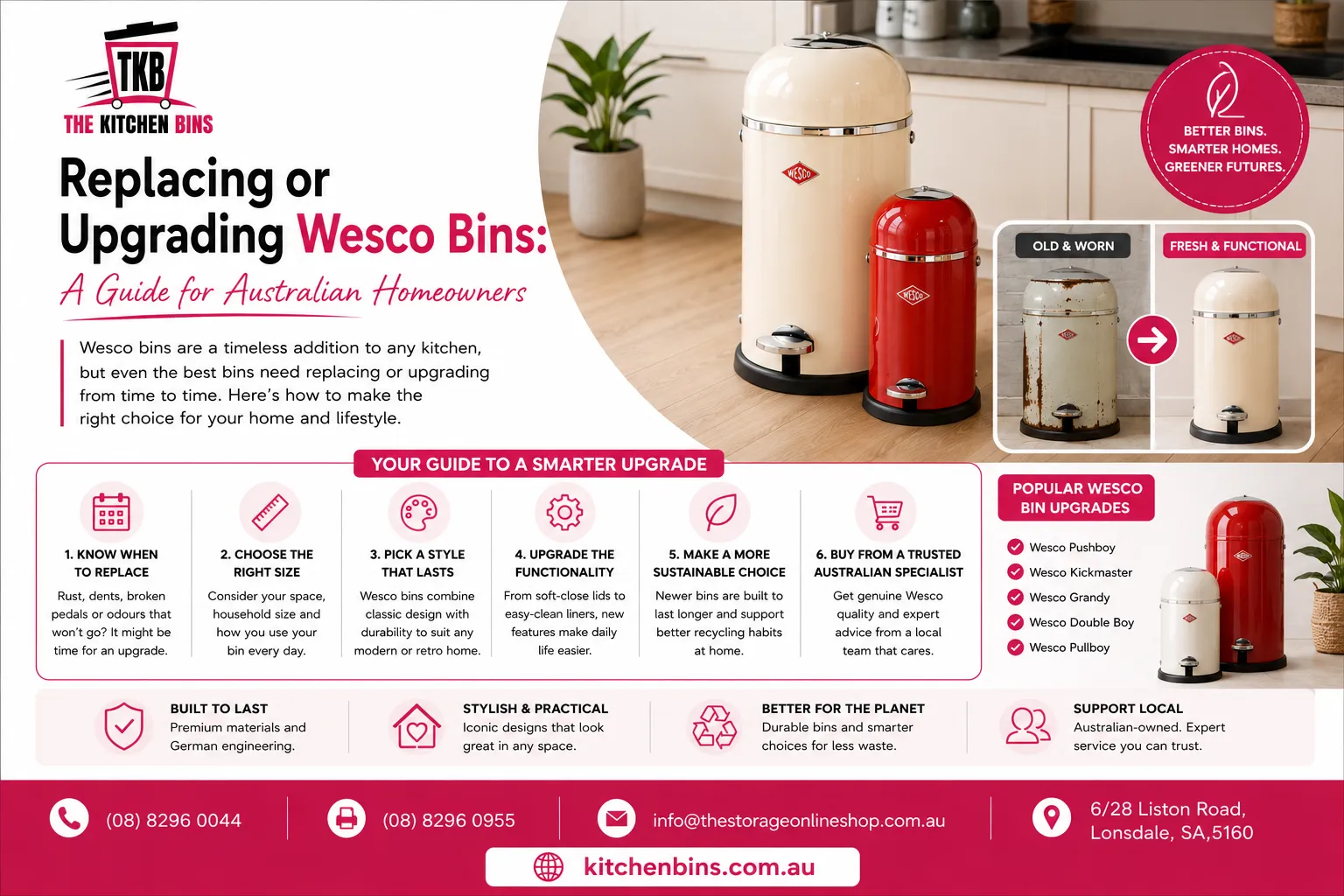
A damaged kitchen bin doesn’t always mean the entire waste system needs replacing.
Sometimes the bucket has cracked while the frame and runners remain in good condition. In other cases the bin still works but no longer holds enough for the household. The challenge is working out whether you need a replacement bucket, a spare component or a complete new system.
Homeowners comparing Wesco bins should begin by identifying the existing unit and measuring the available cabinet space. A few careful checks prevent the most common problem: ordering a bucket with the right capacity but the wrong shape.
Can You Replace Only the Bucket?
In many cases, a damaged or missing bucket can be replaced without changing the complete system.
The replacement must still match the original. Capacity alone doesn’t confirm compatibility, because two buckets holding a similar number of litres may have different widths, heights, rims or base shapes.
Before ordering, check:
-
The product or model number
-
The bucket capacity
-
External bucket dimensions
-
The shape of the upper rim
-
The position of handles
-
The existing frame or support system
-
Any number moulded into the plastic
Photograph the old bucket from several angles for comparison against an online listing.
Don’t dispose of the damaged bucket until the replacement has arrived and been tested. The old one may carry the only visible model number.
How to Identify Your Existing System
Remove the bucket and inspect the complete unit in good light.
Look underneath the bucket, around the rim and inside the cabinet for labels, moulded numbers or product codes. A code may sit on the frame, runner or lid rather than anywhere obvious.
Record the brand name, product code, bucket capacity, cabinet width, number of compartments, frame style, runner type and lid configuration.
Older labels can be difficult to read. Use your phone camera and zoom into the photo rather than squinting while leaning into the cabinet.
When no product code exists, dimensions and clear photographs become critical.
Why Capacity Alone Isn’t Enough
A 20-litre bucket from one system won’t necessarily fit another 20-litre system.
The listed capacity describes how much the bucket holds. It says nothing about external shape, rim position or how it sits inside a frame.
A replacement can fail to fit when the bucket is too tall for the cabinet, the rim is too wide for the support frame, the base doesn’t sit securely, the lid can’t close, the handles catch on the cabinet, or the frame can’t slide fully into position.
Use the product code wherever possible. Without it, compare every relevant external measurement rather than relying on litres.
How to Measure a Replacement Bucket
Measure the old container at its widest and tallest points. You need four measurements:
Width — across the widest outside point, including the rim where it extends beyond the main body.
Depth — front to back at the widest point. A tapered bucket is narrower at the base than the top.
Height — from the lowest part of the base to the highest point of the rim or handle.
Rim dimensions — the complete outside dimensions of the upper rim. This usually determines whether the bucket sits correctly in the frame.
Record everything in millimetres. Small differences matter when a container must fit a fixed metal or plastic support.
Measure the Cabinet Too
Measure the cabinet even when replacing only one part. The existing bin may already be a tight fit, and a replacement with slightly different dimensions could stop the frame moving correctly.
Measure the internal cabinet width, usable depth, available height, width of the cabinet opening, space between hinges, and clearance around pipes or fittings.
The opening is often narrower than the interior because of hinges and door frames. This matters most when replacing a complete Wesco waste bin system rather than a single bucket.
Bucket Replacement or Complete System?
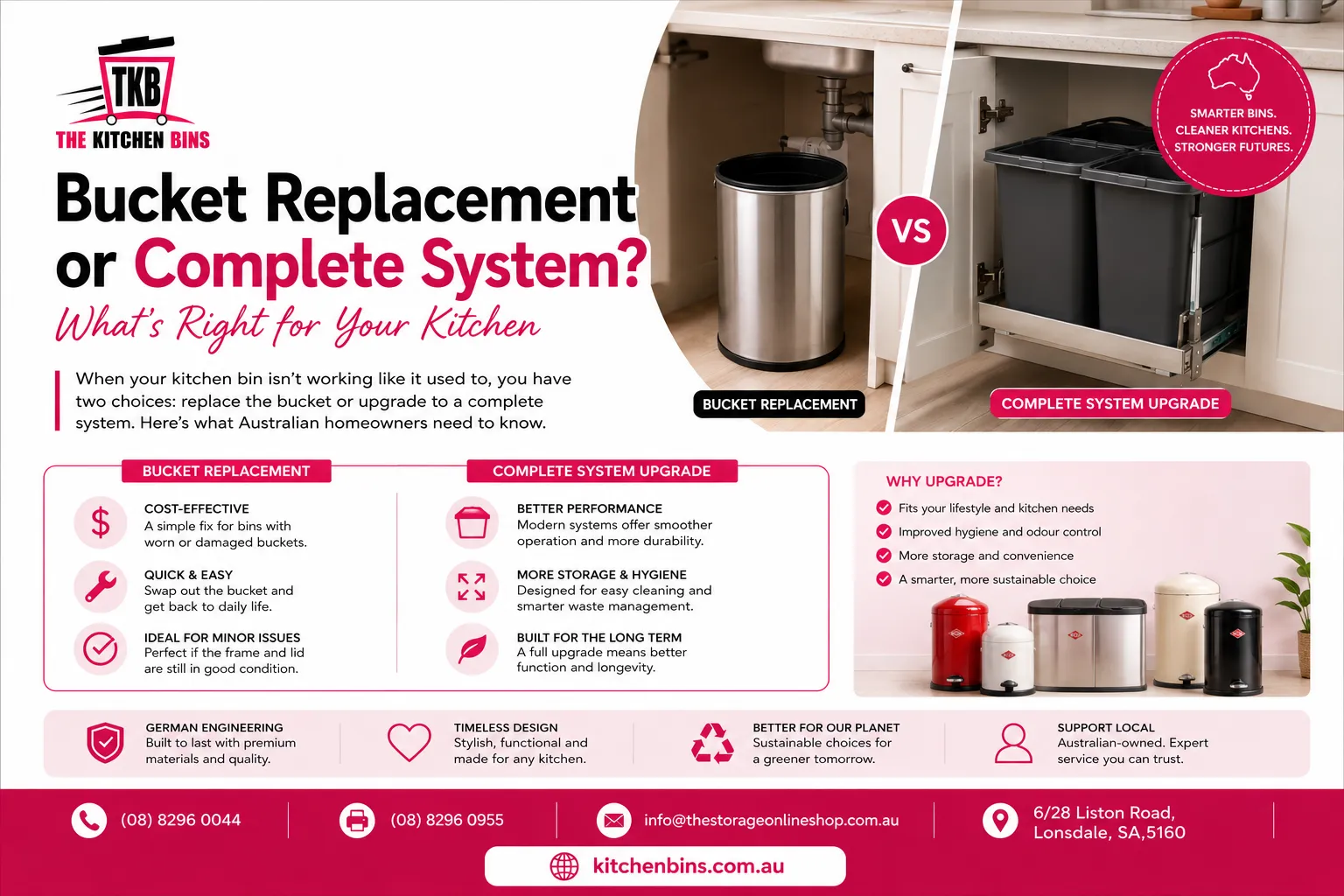
Replacing only the bucket makes sense when the rest of the system works correctly — the container is cracked or stained, a handle has broken, or a bucket was lost during a move, while the frame and runners remain stable and the existing capacity still suits the household.
A complete replacement is more practical when:
-
The runners stick or no longer extend properly
-
The frame is bent or unstable
-
Several components are missing
-
Replacement parts can’t be identified
-
The existing capacity is too small
-
You want separate rubbish and recycling compartments
-
Cabinet changes have made the original system unsuitable
Compare the total cost of multiple replacement components against a complete new unit. Replacing several parts rarely pays off when the original system is already heavily worn.
How Pull-Out Systems Work
A pull-out bin installs inside a lower cabinet and moves forward on runners. Depending on the design, it opens by pulling the cabinet door, an internal handle or the frame itself.
A typical system includes one or more removable buckets, a supporting frame, sliding runners, a lid, cabinet mounting hardware, and on some models a door connection.
Each component must work with the others. A replacement bucket needs to sit securely in the frame without interfering with the lid or the sliding movement.
What to Check Before Buying a Complete System
Minimum cabinet width — check the required internal width rather than assuming based on door size.
Cabinet depth — the bin must slide fully inside without hitting the back panel or plumbing.
Available height — allow clearance for buckets, frame, lid and removal of the containers.
Mounting style — some systems attach to the cabinet base, others to the sides or door.
Individual bucket capacity — a system’s total may be divided across several small buckets.
Door compatibility — confirm whether it’s designed for a hinged door, drawer-style front or internal pull-out.
Single or Double?
A single bin gives more uninterrupted capacity for one waste stream. It suits smaller households, homes storing recycling elsewhere, and narrow cabinets.
A double bin separates two categories in the same cabinet. It suits families separating rubbish and recycling, wider cabinets, and homes producing both waste types frequently.
The compartments don’t need to be identical. A larger recycling container with a smaller general-waste bucket often suits a household producing plenty of clean packaging. Observe what fills fastest before deciding.
Can You Replace Runners or Lids?
Replacement runners, frames and lids are available for some systems. Confirm compatibility using the model number — parts that look visually similar may have different mounting positions.
Before replacing a runner, inspect the cabinet itself. Loose screws, a damaged base or poor alignment can cause sliding problems even when the runner isn’t broken.
When fitting new hardware:
-
Empty and clean the cabinet.
-
Photograph the original installation.
-
Record the position of mounting screws.
-
Compare old and replacement components.
-
Follow the product’s installation instructions.
-
Test the system without heavy waste.
-
Check the cabinet door closes correctly.
Seek professional help when installation requires cabinet alterations or you’re unsure about alignment.
Common Replacement Mistakes
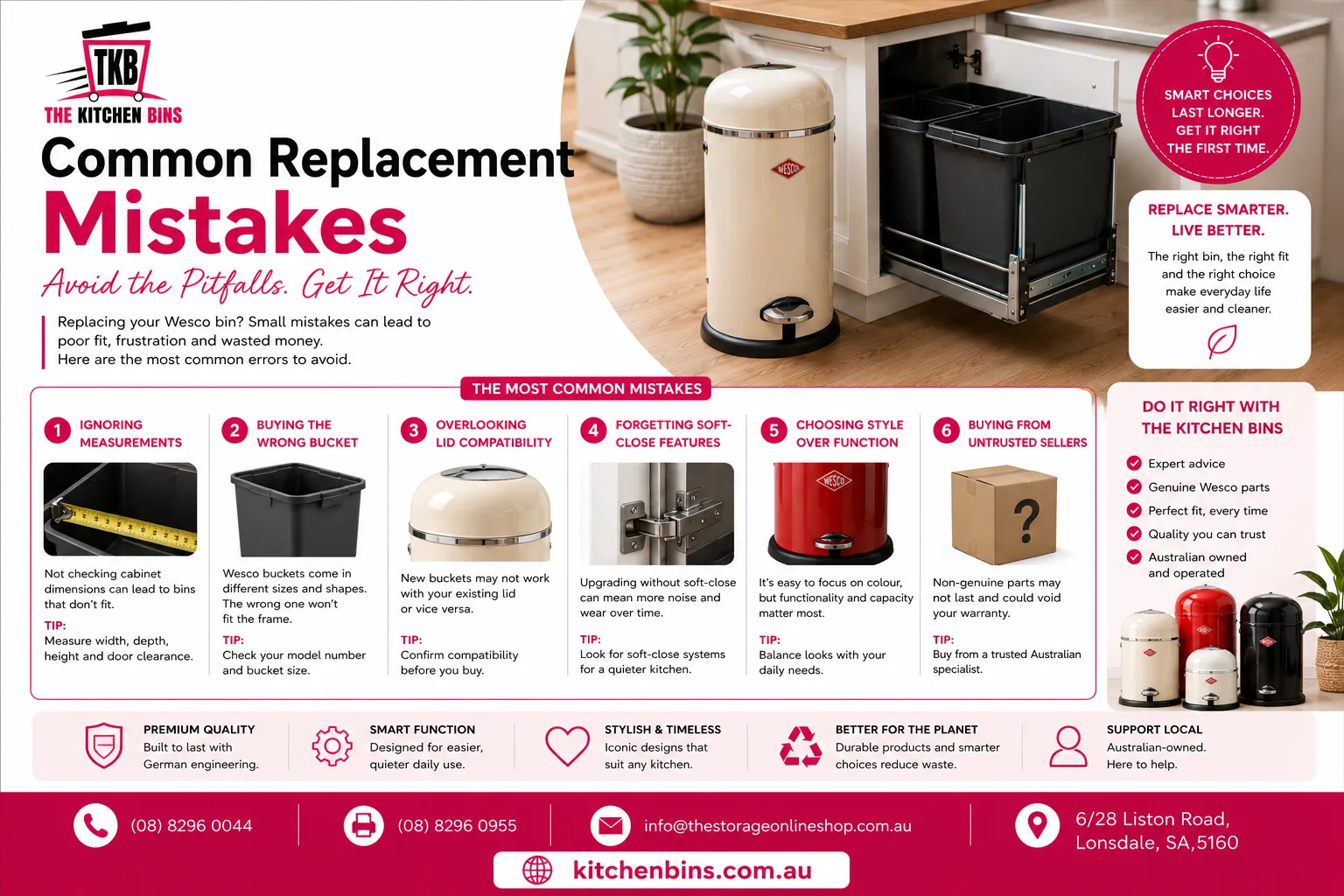
Measuring only the bucket body. The upper rim is often the widest part and determines whether the container fits the frame.
Rounding measurements upward. A small difference stops a bucket sitting correctly. Record exact figures in millimetres.
Ignoring handles. They may add to the total width or height.
Assuming all bins of one capacity are identical. Capacity doesn’t define shape.
Replacing a bucket when the frame is damaged. Inspect every component before ordering.
Throwing away the old part too soon. Keep it until the replacement is installed successfully.
Skipping the cabinet opening. A product may fit inside the cabinet but fail to pass between the hinges.
Frequently Asked Questions
Where can I buy Wesco bins in Australia?
Australian homeowners can buy Wesco bins in Australia from specialist kitchen-bin retailers. Check current stock, specifications and compatibility before ordering.
Can I buy only a replacement bucket?
Replacement buckets are available for some systems. Use the original model number and external measurements to confirm compatibility.
How do I know which Wesco waste bin I have?
Inspect the bucket, frame, lid and runners for a label, product number or moulded code. Record the capacity, dimensions, number of compartments and cabinet size.
Are all buckets with the same capacity interchangeable?
No. Buckets holding the same litres can have different external dimensions, rims and base shapes. Check the model number and measurements.
Can I replace a Wesco bin myself?
A removable bucket usually needs no tools. Replacing frames, runners or door-mounted hardware may require installation experience and careful alignment.
Should I repair or replace?
Repair suits situations where one identifiable component is damaged. Consider full replacement when several parts are worn, compatibility can’t be confirmed, or the capacity no longer meets your needs.
Final Thoughts
Replacing a kitchen bin should begin with identification, not guesswork.
Find the model number where possible, measure the existing bucket carefully and inspect the frame, runners and lid. That tells you whether one component needs replacing or whether a complete upgrade offers better value.
Compatibility matters more than appearance or capacity alone. The correct product should fit securely, move smoothly and make everyday waste disposal simpler.
Taking accurate measurements before ordering is the easiest way to protect your cabinet, avoid returns and keep a reliable bin system working for years.